A revised, updated, Italian version of my cultural history of coffee consumption with a focus on interwar stovetop coffee makers like the Bialetti Moka Express just came out with the LUISS University Press in Rome. The book is accompanied by a new afterword which reflects critically on the economic viability of the “made in Italy” model. But the core of the book assumes the form of an account of how the autarchic cult of national materials promoted by the fascist regime reshaped the design practices of the the 1930s and beyond.
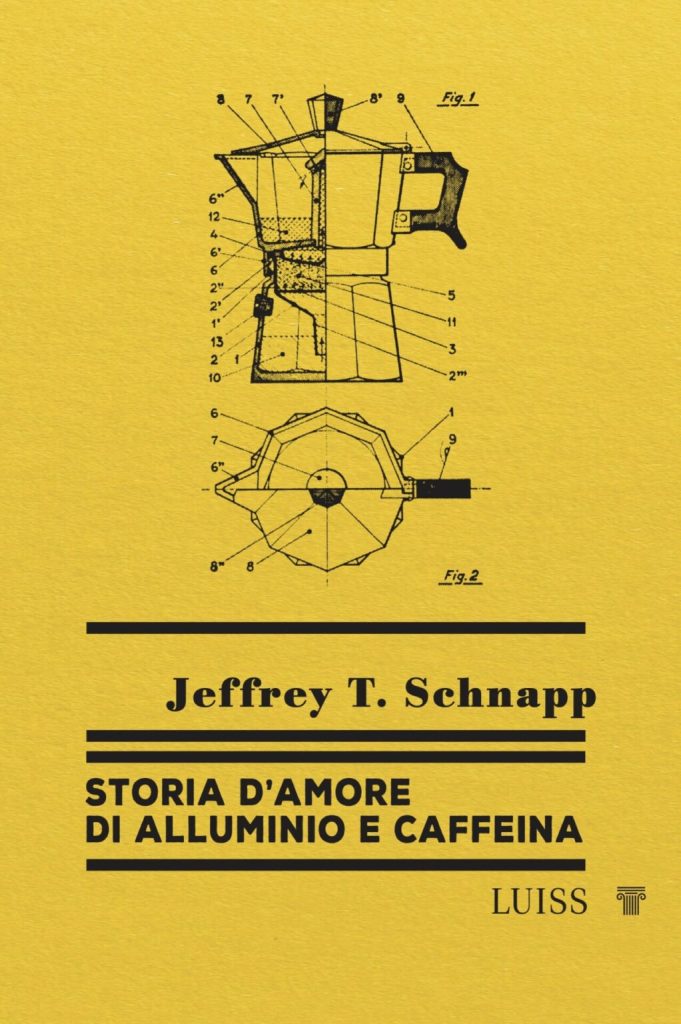
From the liner notes:
Industrial objects can strike us as being without memory, reducible to nothing more than their functions. This way of seeing things strips the material world of its true depth: those extremely fine encrustations of intention and invention, imagination and ideology, tradition and accident that—like a family history—an object carries with it over the course of its existence. Sometimes a single object is enough to tell the story of an entire century. In the case of the Moka, it is almost as if aluminum and caffeine were destined to meet: two elements born far apart which, once brought together, instantly appear made for one another. Their first encounter takes place in Italy in the 1930s: it is the beginning of a love story intertwined with the history of the country, of design, of progress, and of industry. In this essay Jeffrey Schnapp, one of the most authoritative historians of industrial design, binds these materials to the great ideals of the twentieth century: on one side caffeine, emblem of hyper-productivity; on the other aluminum, the metal of innovation. The turning point is their fusion in the Moka Express, Alfonso Bialetti’s famous brainchild: an object capable of embodying modernity, creative drive, and accessible elegance. Through the Bialetti Moka, Schnapp retraces the stages of Italian industrial culture: from domestic object and symbol of Fascist autarchy, the Moka becomes, in the postwar years, an emblem of daily ritual, of work, and of the excellence of Made in Italy. Today, with over 220 million units sold, it has conquered the world thanks to a subtle balance between culture and design. After all, as Schnapp reminds us, industrial objects are never mere functions: they are desires, transformations, fashions, and small gestures of love.
The original English essay was published in a special issue on “Things/Objects,” ed. Bill Brown, Critical Inquiry 28.1 (Fall 2001): 244-69; it was then reprinted in the book Things, ed. Bill Brown, (Chicago: U of Chicago Press, 2004). But the LUISS book provides a revised, updated, and extended version including a brand-new coda. The book is available for sale on the LUISS University Press website.