FALL 2026-2027
SPRING 2025-2026
Comp Lit 166X: Calvino and Computation
FALL 2025-2026
RomStu 201/Comp Lit 291X: (some) questions of theory
with John Hamilton

This year’s seminar builds on that offered some years ago and hinges on a sequence of fundamental questions regarding the literary disciplines and media studies, their history and epistemology. Discussions are instigated by readings in philology, stylistics, media theory, the history of ideas, gender studies, semiotics, structuralism, psychoanalysis, post-structuralism, film theory, genetic criticism, literary sociology, cultural studies, and digital humanities.
This fall’s lineup of questions is:
- What is a seminar on literary and media theory?
- What is literature?
- What is a medium?
- What is a book?
- What is an author?
- What is reading?
- What is generative AI and why might it matter to literary and media studies?
- What is translation?
- What is a literary or media revolution?
- What is criticism?
- What is an image?
- What is human?
- What is the question?
SPRING 2023-2024
COMPLIT 200: Computing Fantasy: Imagination, Invention, Radical Pedagogy (Munari / Rodari / Calvino)

The course combines the study of literary theory and history, literary works such as folktales and children’s stories, and computer-assisted creation employing both textual and visual generative AI tools. By the end of the semester, the class will result in the creation of a carefully crafted and edited volume of illustrated AI folktales. Its central aim is to explore the history of structural, combinatory, and generative thinking about storytelling from Vladimir Propp’s Morphology of the Folk Tale to chatGPT in a manner that combines theory, history, and practice. A key pedagogical objective is to promote the development of critical skills with regard to creative uses of generative AI tools of various kinds.
Three major elements will be brought together within the framework of the course:
- structuralist theories of narrative with a special focus on the primitives–the smallest, most elemental units–out of which stories can be shaped; in this regard, we will be reading excerpts from the work of Vladimir Propp, Algirdas Greimas, and Roland Barthes.
- the critical and creative practice of three major 20th century Italian figures: the prolific designer/artist/design educator/creator of children’s books Bruno Munari, an early pioneer of “programmed art”; the radical educational theorist and writer of children’s books Gianni Rodari; and one of the towering literary figures of the 20th century, Italo Calvino, whose work encompassed major works of fiction (If on a Winter’s Night a Traveler, Cosmicomics, Invisible Cities) as well engagements with combinatory literary composition during his involvement in the Parisian Oulipo group (Georges Perec et alii).
- the study of folktales and children’s books as foundational forms of storytelling.
Bringing together these domains, the course sets out to expand the horizons of contemporary discussions of collaborative human/computational models of literary creation, whether involving LLMS or generative image making.
ARCHIVE (selected courses 2010-2023)
Comp Lit 279 // DES 3364 [GSD]: Knowledge Design: What should or could (scholarly) knowledge look like in the 21st century?


This seminar explores the shapes and forms that knowledge production is assuming in an array of disciplines, from media studies to digital humanities to various domains of design practice to the natural sciences. Each week will be devoted to a separate domain of experimental practice with distinguished guests from both inside and outside of Harvard joining the seminar to talk about their own processes of research, design, knowledge creation, presentation, and publication. The aims of the course are: a) to expose participating students to these emerging practices and to leading practitioners, b) to offer an opportunity for sustained critical reflection regarding the strengths and weaknesses of both novel and traditional models, c) to provide hands-on experience with some of the techniques and practices that are involved, and d) to serve as a catalyst for innovative thinking regarding participants future or ongoing work. The course is built around the redesign of a classic or authoritative work from the student’s own field of specialization. (The image above is how MidJourney visualized the present abstract.)
COMPLIT/ITAL 245: A Fascist Century – A research seminar on fascism, culture, and the genealogy of the radical right

On the one-hundred year anniversary of the March on Rome, this seminar provides an in-depth understanding of fascism, its intellectual and political roots, its critique of liberal democracy and communism, and its legacies, with particular attention to fascism’s cultural expressions. Its first half will be devoted to readings from key fascist thinkers and theorists; its second half to a series of case studies of major artists, writers, architects, and film-makers who embraced the fascist faith: among them Ezra Pound, author of the Cantos, one of the masterpieces of 20th century American poetry; Leni Riefenstahl, the German film director of classic documentaries such as Olympia and Triumph of the Will; F. T. Marinetti, founder of the Italian Futurist movement; and Mario Sironi, the leading painter, muralist, and graphic artist of the so-called Lictorial Style. Course themes will include fascism vs. nazism; collectivism vs. individualism; radical right attitudes towards technology and industrialization; and comparisons between mid-20th century fascisms and the sub-cultures of the contemporary new right.
DIGITAL IDENTITY IN TIMES OF CRISIS: A RESEARCH SPRINT

The Berkman Klein Center for Internet & Society, in collaboration with metaLAB (at) Harvard, the Edgelands Institute, and AccessNow, is hosting a Research Sprint during the Fall 2022 semester that focuses on the ethical, human rights and societal impacts of digital identity in times of crisis.
GSD 4426: The Spectacle Factory

The Spectacle Factory examines the modern history of immersive theater, entertainment, and media spaces from the standpoint of the history of architecture and design. It is concerned with how such spaces have been shaped by the interplay of cultural needs and fantasies, technological possibilities, political ideology, and architectural tradition and invention. All built spaces are immersive in the some sense of the word. So by emphasizing the immersivity of a small subset of architectural spaces, modern and contemporary culture has assigned to these a distinctive functions that go beyond the ordinary meaning of the word immersive: functions that encompass liminal domains of perception, sensation, and experience associated with the sacred (hallucination, ecstasy, trance, psychosis, transcendence) as well as with new forms of recreation and play.
ROM 300: Writing in the Romance Literatures

Romance Languages 300 is a yearlong, hands-on, practice-oriented workshop for graduate students devised to support the work of dissertation authors, their advisers and thesis committees, by providing a forum in which students have the opportunity to discuss questions of technique and strategy related to the writing of the Ph.D. dissertation, and to present work in progress to an audience of their peers. In so doing, it seeks to encourage innovative approaches to the design, structure, and documentation of contemporary scholarship in the literary domain. Most sessions are devoted to workshopping the manuscripts of seminar participants, though outside experts, from recent RLL Ph.D.’s to faculty to publishers and editors, will also join the group upon occasion.
ITAL 247: Material Culture in the Middle Ages: Dante’s Commedia
This advanced research seminar seeks to open up a set of new perspectives on Dante’s poem on the occasion of the 700th anniversary of his death. The course will combine close scrutiny of Dante’s text with nuanced attention to strategies of literary allusion, cross-reference, and reworking, via a series of in-depth explorations of the material culture of Dante’s era. It begins with an intensive reading of the poem in its entirety and then transitions to ten case studies, one per week, each of a single building block of Dante’s world. The case studies in question are dedicated to:
- THE PATH (TRAVEL ON LAND)
- BOATS (TRAVEL OVER WATER)
- TREES
- SOIL
- DOORS AND DOORWAYS
- BLOOD
- COLOR
- FLIGHT (TRAVEL BY AIR)
- SOUND
- MIRRORS
Each unit will be tackled via a corpus of passages from the Commedia, culled in the course of our first week of readings, that are placed in dialogue with readings of primary source materials from medieval encyclopedias, ancient and early modern science, and contemporary studies of material culture in the Middle Ages. The aim of the readings is to build a framework that will provide a set of estranging perspectives from which to revisit key features of the Commedia. These will, in turn, “seed” the research projects that participating students will carry out over the course of the semester and present in the final meeting of the seminar.
Comp Lit 188: Futurisms (A comparative history)

From its foundation in Feb. 1909 through WWII, futurism developed into the first truly international cultural-political avant-garde. Its aim was a revolutionary transformation of all spheres of life and its influence extended to the whole of Europe, Asia, and the Americas. Combating the traditionalism and provincialism of turn-of-the-century European culture, the movement sought to found a cosmopolitan (but often nationalist) counterculture based on the exaltation of youth, speed, violent revolt, innovation, and experimentation. Hence the movement’s name: the label “Future-ism” denoting at once adoration of the new and struggle against the prevalence of “past-ism” or passatismo/passéisme (the idolatry of the past). In its first decade of existence Futurism became the first full-fledged cultural/political avant-garde of our century, gathering together painters, musicians, architects, political revolutionaries, and poets from several European nations. A key progenitor of later movements such as Dada, Vorticism, Surrealism, and Fluxus, Futurism had a powerful formative influence not only on the cultural atmosphere of Italy during the Fascist era (1922-1945), but also on 20th century culture as a whole. Its contemporary legacies are many and extend from popular culture to the experimental art of our time. This seminar will examine the movement’s various manifestations in Italy, France, England, Russia, Spain, Latin America, and Eastern Europe. In addition to Filippo Tommaso Marinetti, a wide range of writers and visual artists will be considered, including A. G. Bragaglia, Apollinaire, Mayakovsky, Malevich, Lissitzky, and Léger. Topics will include: machines and culture; the theater of surprise and futurist performance art; Futurism’s ties to anarchism, bolshevism, and fascism; words-in-freedom poetics; experiments with typography, photography, radio, and film; futurism’s interest in transforming the character of books; futurism’s impact on exhibition design; and futurism’s legacies in postwar culture.
HIS 4389 [GSD]: 14 Things (A Secret History of Italian Design)

Fourteen Things explores intertwinings between design, science, technology, society, art, and culture by means of the “excavation” of fourteen objects from different periods in the history of modern Italian design, from the turn of the 20th century to the present. Combining micro- and macro-perspectives, it approaches design history from a broad aesthetic, historical, and socio-anthropological standpoint. The seminar combines readings from contemporary Thing Theory, material culture studies, and design history, with materials from literature, popular culture, and media. It is built around a chronologically ordered sequence of case studies of exemplary things: artifacts designed for purposes of sitting, drinking, lighting, walking, moving about, cooling down, cooking and cleaning, writing and calculating, or media viewing. A video introduction to the course is available at https://www.gsd.harvard.edu/course/14-things-a-secret-history-of-italian-design-offered-with-fas-spring-2019/.
FRSMNR 620: Who is a fascist?

The seminar provides an in-depth introduction to fascism, its intellectual and political roots, its critique of liberal democracy and socialism, and the traces fascism has left on the contemporary cultural-political scene from Marine Le Pen’s Rassemblement National to the American alt-right to populist insurgencies like Trumpism. It begins with readings from key fascist thinkers and theorists, before surveying a series of domains where artists, writers, architects, film-makers, and engineers sought to interpret and embody the “fascist revolution” not just in Italy but worldwide. Among the figures considered are mystical nationalists like Gabriele D’Annunzio; Filippo Tommaso Marinetti, founder and leader of the Futurist movement; the American poet Ezra Pound, author of the Cantos, one of the masterpieces of 20th century American poetry; Leni Riefenstahl, the film director of classic documentaries such as Olympia and Triumph of the Will; the architects Marcello Piacentini and Adolf Speer, the former Italy’s leading designer of public monuments and buildings during the Mussolini era, the latter Hitler’s preferred architect; and the engineer Gaetano Ciocca, creator of everything from Corporativist pig farms to mass-produced worker housing to mass sports stadia. Seminar themes will include: fascism vs. nazism; collectivism vs. individualism; radical right attitudes towards technology and industrialization; and examinations of the convergences and divergences between mid-20th century fascisms and the sub-cultures of today’s alt-right. The capstone project for the semester will involve an original research project focused on a contemporary alt-right group.
RS/Comp Lit 201: (some) questions of theory VI
with John Hamilton

This year’s seminar builds on that offered over the past few years and hinges on a sequence of fundamental questions regarding the literary disciplines, their history and epistemology. Discussions are instigated by readings in philology, stylistics, the history of ideas, gender studies, semiotics, structuralism, psychoanalysis, post-structuralism, film theory, genetic criticism, literary sociology, cultural studies, and digital humanities.
This fall’s lineup of questions is:
- What is a seminar on literary theory?
- What is literature?
- What is a book?
- What is an author?
- What is reading?
- What is a medium?
- What is translation?
- What is a literary revolution?
- What is literary criticism?
- What is a (literary) place?
- Who is literature?
- What is the question?
DES 3371 [GSD]: Robots In & Out of Buildings (seminar)
with Greg Lynn
New forms of mobility are currently being developed for the transport of both people and goods. From autonomous container ships and trucks, to autonomous buses and cars, to autonomous aerial and land drones, logistics and transportation is being reformulated. These new forms of intelligent motion are already beginning to reshape urban, suburban and rural environments. But little thought is being devoted to how buildings, their circulation and envelopes, and their interconnection to the urban landscape will be transformed by the proliferation of robotic agents whose electric drive trains allow them to move freely around building interiors as well as across thresholds between interiors and exteriors. The premise of the research seminar is that robotic vehicles promise to alter building typologies no less profoundly that did the elevator and escalator in their respective eras. The seminar builds on the work carried out in this fall’s studio (see below) dedicated to exploring the premise that robotic vehicles promise to alter building typologies no less profoundly that did the elevator and escalator in their respective eras.
TOPICS & QUESTIONS
• Can spaces be more intensively used as furniture gains location awareness and mobility? What new spatial arrangements and opportunities are possible?
• How are buildings oriented given the various scales, speeds and rhythms of transportation systems that move around, through, between, and within buildings?
• Do robots enter buildings with people, with vehicles or in new locations?
• Do people and robots share the same circulation spaces within buildings?
• How can mechanical, electrical, plumbing, communication and fire suppression systems be mobilized throughout buildings?
• Can the territory of a building expand and contract throughout the day, season or lifecycle with the introduction of intelligent mobile robotics?
DES 3370 [GSD]: Robots In & Out of Buildings (studio)
with Greg Lynn
New forms of mobility are currently being developed for the transport of people and goods. From autonomous container ships and trucks, to autonomous buses and cars, to autonomous aerial and land drones, transportation and logistics are being reformulated. New forms of intelligent motion are already beginning to reshape urban, suburban, and rural environments. But little thought is being devoted to how buildings, their circulation and envelopes, and their interconnection to the urban landscape will be transformed by the proliferation of robotic agents whose electric drive trains allow them to cross thresholds and move freely around and between building interiors and exteriors.
The premise of the research studio is that robotic vehicles promise to alter building typologies no less profoundly that did the elevator and escalator in their respective eras. Research will be conducted to familiarize the students with the various scales, speeds, and rhythms of transportation systems that move around, through, between, and within buildings in smart cities, and assess their impact on human activity and experience at a range of scales. Only current technologies will be considered, including: autonomous trucks, semi-autonomous cars, autonomous land drones, autonomous aerial drones, warehouse robotics, security robots, autonomous fork lifts and pallet carts, health care robots, and domestic cleaning and security robots. Once participants are familiar with the capacity and sensibilities of these intelligent moving vehicles and platforms, the course will shift to devising problem statements regarding design opportunities for architects such as, but not limited to: Circulation: Do people and robots share the same circulation spaces within buildings?; Envelopes: Do robots enter buildings with people, with vehicles, or in new locations?; Systems: How can mechanical, electrical, plumbing, communication and fire suppression systems be mobilized throughout buildings?; Landscape: Can the territory of a building expand and contract throughout the day, season, or lifecycle with the introduction of intelligent mobile robotics?; and Typologies: How might these domains and elements merge and mesh in ways that will allow for new varieties of adaptive architecture? Could buildings and the robotic systems that inhabit them share the same algorithmic infrastructures?
Comp Lit 279 // DES 3364 [GSD]: Knowledge Design: What should or could (scholarly) knowledge look like in the 21st century?

This Humanities Studio seminar will explore the shapes and forms that experimental scholarship is assuming in an array of arts and humanities disciplines, from media studies to digital humanities to cultural analytics. It will also explore emergent models of knowledge production and publication within and across media. Open to advanced undergrad and graduate students, and to students from the Graduate School of Design.
ITAL 245: The Fascist Century: A research seminar on Fascism and Culture

This course will provide an in-depth introduction to fascism, its intellectual and political roots, its critique of liberal democracy and communism, and its legacies, with particular attention to fascism’s cultural expressions. Its first half will be devoted to readings from key fascist thinkers and theorists; its second half to a series of case studies of major artists, writers, architects, and film-makers who embraced the fascist faith: among them Ezra Pound, author of the Cantos, one of the masterpieces of 20th century American poetry; Leni Riefenstahl, the German film director of classic documentaries such as Olympia and Triumph of the Will; F. T. Marinetti, founder of the Italian Futurist movement; and Mario Sironi, the leading painter, muralist, and graphic artist of the so-called Lictorial Style. Course themes will include: fascism vs. nazism; collectivism vs. individualism; radical right attitudes towards technology and industrialization; and comparisons between mid-20th century fascisms and the sub-cultures of the contemporary new right (from Jean-Marie Le Pen’s “Front National” to Baathism to the American militias to so-called “Islamofascism”).
Humanities Studios 4: The Mixed Reality City (Transit Symphony)
The contemporary city is constituted by multiple overlapping, intermixing realities articulated across built form and imagined space, individual experience and collective memory, embodied sensation and digital mediation. Often, these multiple realities are invisible or illegible, with certain narratives dominating particular environments. However, realities always leave traces, to be excavated and reconstructed. The Mixed-Reality City is an exploratory research seminar and workshop in which students pursue studies of urbanism-in-the-making through means and methods emerging in the digital arts and humanities, including: data narrative, digital ethnography, adversarial design, and critical technical practice. The course focuses in equal parts on unpacking discourses and developing interpretative digital artifacts. The course will illuminate distributed spaces of urban activity that take on collective identities through networked events, ranging from the mundane (a conversation) to the momentous (a hurricane). Indeed, spatial events and phenomena are connected across cities by information technologies. Social networks, participatory maps, and online media collections are shaping mixed-city social spaces. In 2013, the image of the city is a composite image, in which fragments of dispersed urbanism are drawn together and entangled online. The Mixed-Reality City will explore how artists and designers might intervene in this emergent, hybrid cityscape.
Gen Ed 51: The Cosmos of the Comedy

“The Cosmos of the Comedy” provides an in-depth introduction to Dante Alighieri’s 14th century masterpiece, the Comedy, as a point of entry to the history of Western poetics, philosophy, natural science and cosmology. The course combines attention to Dante’s dialogue with classical antiquity in these and other fields with exercises in critical writing and in multimedia translation and adaptation aimed at prompting critical reflection on the ways in which present cultural practices are built upon the practices of the past. The core of the course consists in intensive study of Dante’s encyclopedic poem in relation to the culture and history of Medieval Europe. Major topics to be covered include: concepts of modernity and antiquity in the Middle Ages; shifting notions of Latin and vernacular authorship during the 13th and 14th centuries; vernacular poetics and the medieval genre system; high medieval manuscript culture and/in the Comedy; gender and genre in Dante and the 12th-14th century lyric; medieval and ancient theories of history; allusion; Dante, Aristotle and the natural sciences; classical and medieval language theory; Virgil and Ovid in the Middle Ages; Dante’s concepts of universal monarchy and the illustrious vernacular; myth and theology in Dante’s Christian poetics; the reception history of Dante’s work, 14th century to present.
Humanities Studio 2: HOMELESS PAINTINGS OF THE ITALIAN RENAISSANCE
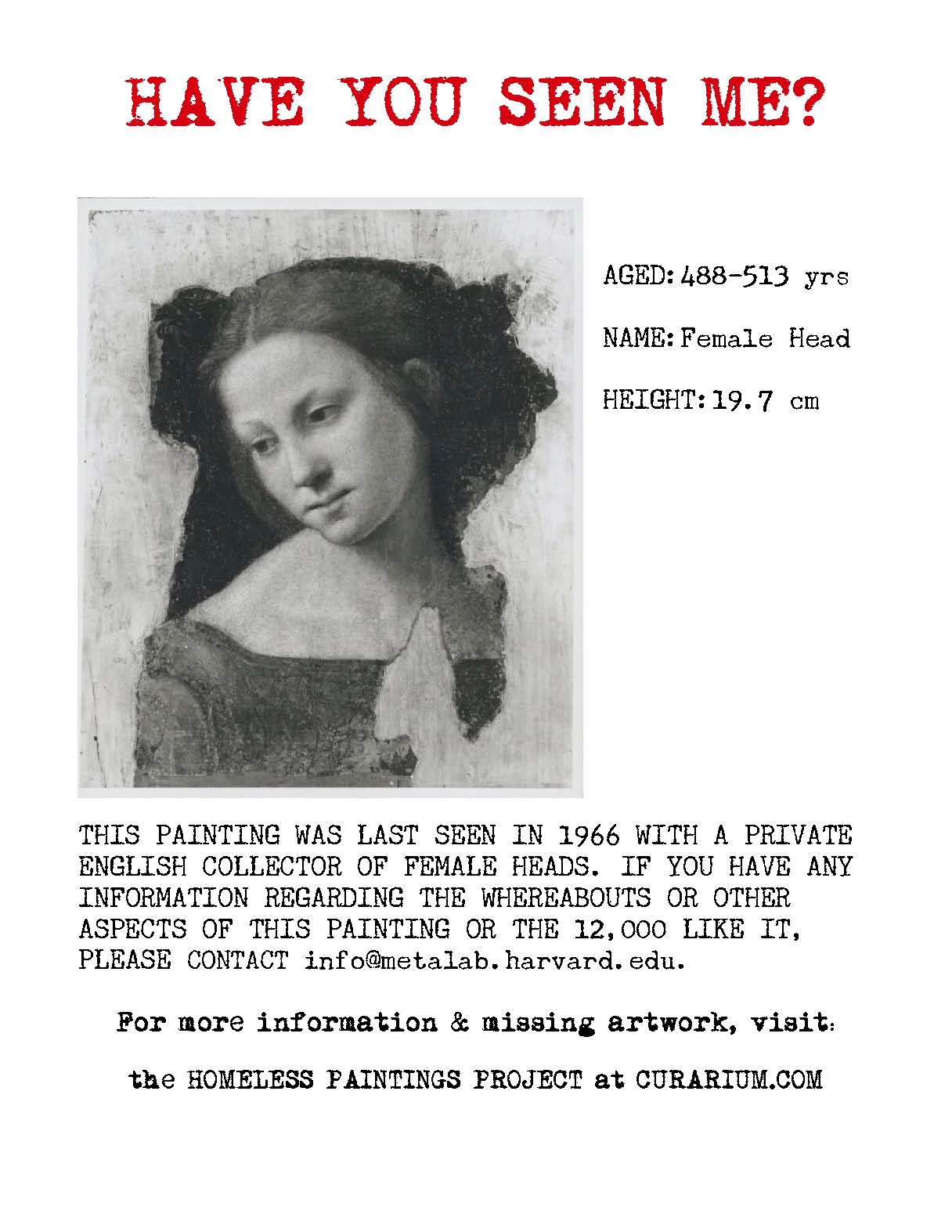


Amidst the archives that Bernard Berenson bequeathed to Harvard is a collection of 16,000 photographs of Renaissance paintings classified as “homeless”: works documented by photographs whose location is unknown. The studio will explore the curatorial possibilities of this corpus and develop an “animated archive” using the web-based Curarium platform. It will identify, describe, and interpret objects in the collection; reconstruct the stories of lost or destroyed works; and investigate the historical and cultural dimensions of lost art, including the role of dealers, market forces, and desire; the ephemeral nature of art; and the photographic documentation of treasured objects.
Humanities Studio 1: COLD STORAGE — An interactive documentary project
with the metaLAB team
Libraries are not mere repositories, but sites breeding strange hybrids of knowledge, people, and material things. Building on the strength of two years of work in the Library Test Kitchen, this studio will research and produce an experimental documentary exploring library hybrids, with special focus on the Harvard Depository, where nine million of the documents that make up the university’s collections are stored. Students will explore the cultural and technical dimensions of libraries, depositories, and storage facilities; produce ethnography, oral history, and other writing; practice video production and editing; and engage in website design and development. Students with interest in the history of libraries or with media production or technical skills are particularly welcome.
RS 220: Fragments of a Material History of Literature
The seminar provides a series of occasions for critical reflection on and expressive response to the complex interplay between cultural constructs and the media within which they are formalized. It is intended as a stimulus to research into the material foundations of institutions of literary study and to sustained reflection on the blind side of contemporary theorizations concerning textuality, writing, and media. It engages such topics as:
- the history of literacy and its relation to other modes of expression: oral, graphic, audio, televisual, and networked
- the transition from scroll to codex, manuscript to printed book, machine-produced to electronic document
- shifting systems for organizing, associating, and managing textual material, such as page numbers, indices and tables, paragraphs and punctuation, and annotation and cross-reference
- the affordances and effects of storage: the library as a site that manages and problematizes the material nature of writing; the archive as memory and treasury
- the materially-coded status of literature relative to other forms of written communication
- the shifting line between private and public forms of discourse
- media permutations of such concepts as authorship, voice, style, and literary quality
- the socially-embedded nature of literary artifacts, from keepsake to vade mecum to commodity
- theoretical, bibliographic, and literary schematizations of literary materiality
- the artifactual nature of literary objects as sites of archaeology, history, and connoisseurship
- the ways in which books learn: how the material transformations of a given text through time express continuity and change
The seminar’s core hands-on exercises are integrated into metaLAB’s Teaching with Things project.
Hist Sci 297: Digital Power, Digital Interpretation, Digital Making
with Peter Galison (History of Science), Martha Minow (Harvard Law School) and Jonathan Zittrain (SEAS, Harvard Law School)
Harvard is beginning a new initiative to explore intersections between digital power, digital making and digital interpretation. This is a working seminar designed to examine questions within those domains through a cluster of projects designed to merge theoretical and critical inquiry with making. For example: What is the health of the Internet and how could we construct ways to measure it? To what degree ought our online and offline lives to converge or to diverge? What is the nature of public space in the age of ubiquitous communications networks and the world wide web? How are notions of political participation, privacy, and social norms being reshaped by the digital revolution? How should we reimagine institutions such as libraries, archives, schools and universities for the digital age? How can digital filmmaking connect with new forms of interactive design and exhibition? How are cultural, cognitive and communicative models being altered by digital media?
GSD 3498: Library Test Kitchen
with Jeff Goldenson (Library Innovation Lab) and Ann Whiteside (Loeb Design Library)
Bridging the analog and the digital worlds, the offline and the online, libraries and learning spaces represent one of the most exciting opportunities for design and redesign on the contemporary scene. Library Test Kitchen is a fast prototyping lab for the modeling smart spaces: spaces of learning, thinking, serious play, contemplation of and interaction with knowledge. It provides students the unique opportunity to develop and fully realize their design ideas on a 1:1 scale within the setting of one of the world’s greatest research library systems –the Harvard Libraries– and Harvard University as a whole. The Harvard Library system is in the midst of unprecedented transformation. As part of the process, the system’s own Innovation Lab has financed the Library Test Kitchen for a second year. Not just as an engine of local change, but also as a driver of innovation on a national and international stage. The course assumes the form of a studio devoted to critical and speculative thinking, hands-on problem solving, fabrication and making. In addition to the Harvard libraries, the course’s network of clients and collaborators includes major public library systems nationwide.
GSD 3498: BIBLIOTHECA: The Library Past/Present/Future
with John Palfrey (Harvard Law School)
This seminar combines exploration of the history of the library as an institution of knowledge storage, retrieval and production with a design studio concerned with a series real-world problem sets involving library spaces on the Harvard campus as well as the future shape and functions of library spaces. Topics include: libraries in the cultural imagination, library infrastructures from registers to card catalogues to digital catalogues, the history of shelving systems and lecterns, library architectures from the Library of Alexandria to the Digital Public Library of America.
xpCrit/Digital Humanities 2.0: a metaLAB (at) Harvard seminar
A seminar and workshop for the development of semester-long projects, the course provides an introduction to new scholarly models in the arts and humanities via readings, case studies and conversations with expert practitioners.
Boccaccio and/on Authority (Latin to Vernacular, Vernacular to Latin)
This course provides an in-depth survey of Giovanni Boccaccio’s experiments in a range of genres from epic to elegy, narrative to allegory, geography to mythography. It emphasizes the question of the relation between vernacular and Latin models of authorship and Boccaccio’s engagement with both ancient and contemporary sources.
